I don't think I can make quite the impact that I'm looking for here, so I've moved elsewhere for good.
Thanks for sticking around, but here's where I'm at now:
http://mediaenvironment.wordpress.com/author/laurenkeith/
For Media and the Environment class.
http://www.kansan.com/blogs/tip_melting_iceberg/
The rough beginnings (and slight re-hash) of a blog
http://www.kansan.com/staff/lauren_keith/
All of the columns I've written for Jayplay.
Peace, love and all that hippie shit,
LK
Friday, March 7, 2008


Monday, January 28, 2008
Word Vomit
I hope that this blog will be more than a regurgitation of what I will be writing every week for Jayplay, a soon-to-be blog at kansan.com and about 250 words a week over at WordPress.
Just know that you can find me elsewhere.
Here is a link to my first column in Jayplay.
And the second.
Check back every Thursday (including the one in two days!) for more more more.
Just know that you can find me elsewhere.
Here is a link to my first column in Jayplay.
And the second.
Check back every Thursday (including the one in two days!) for more more more.
Thursday, November 29, 2007
To Return, Yet Again
The writing will come back in two weeks.
Riding the train home was amazing.
I hope I look like Al Gore with the new Mac.
Thanks for asking.
Yours,
LK
Saturday, November 10, 2007
If All Else Fails, Read The Directions

So after writing my last post about reading labels, I was shocked to discover that I had forgotten to read a label and was now eating some rather interesting ingredients, including cow, brown and condensed. My hypocrisy rages on.
...
If you know anything about me, you know how much I love a good list. From To-Do lists to "This Is Fucking Urgent" lists, list-making has probably consumed more of my life than actually accomplishing the items on them.So this week's blog is dedicated to the wonderful simplicity of the list.
Top 5 Things I Will Never Again Buy At A Non-Organic Grocery Store
1. Fruits/vegetables: Granted that I rarely eat the latter, I don't really want my Top 5 Things I Will Never Again Buy At A Non-Organic Grocery Store
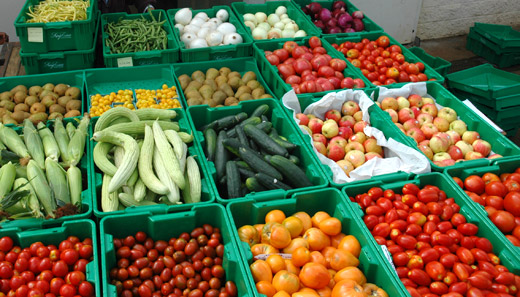 guinea pig to be laden with chemicals. Lawrence has such an amazing farmer's market that I don't know how I can warrant buying produce that comes from halfway across the world. Even if you can't always afford all organic foods, picking certain foods to always buy organic is beneficial. According to the Environmental Working Group, consumers should avoid the "dirty dozen" in produce, a group of the most contaminated conventionally grown fruits and vegetables. The "dirty dozen" are apples, bell peppers, celery, cherries, imported grapes, nectarines, peaches, pears, potatoes, red raspberries, spinach and strawberries.
2. Shampoo/makeup: Obviously made up of too many unpronounceable chemicals that are still frequently tested on animals like guinea pigs. Products that have the leaping bunny logo are certified cruelty-free, and many do not contain any animal by-products.
 3. Cleaning products: Again with the chemicals. Most go right back into the city's water system, which could end up in your drinking glass. Method is the brand I usually buy, but there are many more out there (I'm also way too much of a sucker for good design).
4. Meat products: If you just can't let go of your steaks, try to eat the lesser of two evils. Always buy organic, cage-free, free-range, plant-fed meats.
5. Light bulbs/batteries: These do not necessarily have to be purchased at an organic grocery store, but look for the Energy Star label, which cuts down on waste from appliances and light bulbs. Use rechargeable batteries whenever possible to reduce landfill waste. The initial cost isn't cheap, but like many other products, the batteries will quickly pay for themselves.
Four Books That You Should Read Relatively Soon

1. An Inconvenient Truth by Al Gore: I know, I know. But if you don't think you can sit through the entire movie or if you want a little more in depth discussion of the examples given and the numbers behind them, the actual print source is a good place to turn. 321 pages.
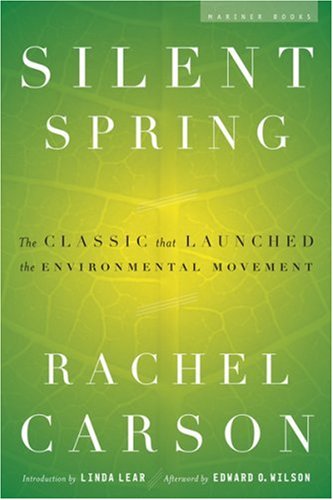 2. Silent Spring by Rachel Carson: One of the first reports into pesticide use in agriculture. This book is usually attributed to the outlaw of DDT use in the United States and is commonly called the "cornerstone of modern environmentalism." A bit tough to get through if you're not into plants and chemical formulas but a good read nonetheless. 297 pages.
3. Collapse by Jared Diamond: This book details the collapse of previous high-and-mighty
 civilizations, such as the Incas, the Mayans and the Vikings. It also discusses current population and environmental issues, especially in Africa. This book serves as a frightening but necessary reminder that a collapse can happen to any civilization at any time, including ours. 525 pages.
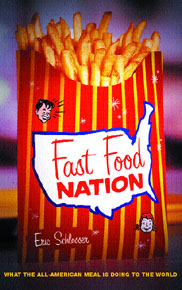 4. Fast Food Nation: Unfortunately, the movie does no justice to this book. Still eating McDonald's hamburgers but know that you should really stop? Favorite quote: "There's shit in the meat." Drop the patty. 288 pages.
Three YouTube Videos to Watch: White Owl Need Not Apply
1. GOOD Magazine: E-Waste
Sometimes a little cheesy but a good message. Check out their other videos about plastic bags and nuclear weapons.
2. FOX News Attacks the Environment
Nice incredibly offensive opening line to get your attention there. Even Rupert Murdoch acknowledges that business needs to change but apparently the anchors themselves think otherwise. And how I love clips of good ol' Papa Bear O'Reilly.
3. "Earth to America" With Blue Man Group
Love these guys!
Two Things I Can't Give Up (Yet)
I'm not perfect either, and we all have our downfalls. Becoming green and living lightly on the earth is a gradual process that still trying to adapt to as well.
1. New books and magazines: Too appealing. However, I always try to purchase books and magazines on recycled paper and from publishing companies that use green energy.
2. New clothes: To an extent. My latest fascination is American Apparel, soon to be in the Plaza in Kansas City. Always look to see where your clothing is made. Gap got busted a few weeks ago for using sweat shop labor. How inspi(red).
One Website You Should Go To Right Now
1. USA TODAY's candidate match game. (thanks Harrison!) Find the perfect presidential candidate for you and adjust issues accordingly at the end. Like I need another excuse to be absolutely in love with this newspaper.
LK
Sunday, October 28, 2007
A Certain Shade of Green
In light of recent Facebook notes (yes, that’s what our world is coming to), this week I’ve decided to tackle the topic of media and the environment. And before you tell me about how shitty the media is, you don’t have to. I know. It’s thrown in my face almost every day that I’m a couple years away from working in an industry that loves little more than celebrity gossip and murders.
And now that being green is the new black, the media are finally turning their cameras toward the issue.
After years of schooling, journalists receive a diploma and tattoos of “get both sides of the story” carved into their wrists and the word “controversy” in a heart after they crossed out “Mom.” However, both sides don’t exist for every story, and this is usually the case when it comes to stories on scientific reports that are based on consensus.
The media are also obsessed with controversy. At times, we try to create doubt and raise questions when the issue has already been settled. I’m not advocating that journalists silence themselves, but when we try to find the other side to a scientific consensus, we usually end up finding a source that lacks valid credentials.
This has happened on several Web sites that dispute the science of global warming, such as junkscience.com. Steven Milloy runs this site and is the commentator for the site on FoxNews.com. Not surprising.
Recently, Junk Science’s main feature has been trying to get Al Gore to debate “climatologists” that Milloy rounded up. So far, Al Gore has refused, further riling up the critics.
It’s no wonder Al Gore has refused. Some of these so-called climatologists have pretty-sounding degrees from wonderful institutions, but they are simply cronies who are now paid by Big Oil and Big Business. The most notorious on the panel is Fred Singer, a man who has a PhD from Princeton, but no longer uses his scientific judgment to further the truth. Last semester, a good portion of one of my environmental policy classes was devoted to talking about Singer’s background.
Singer, along with Milloy and most likely others in the group, have close ties with the oil and tobacco industries. And ironically enough, they spread false claims about global warming and the links between smoking and cancer.
The New Republic found out that Philip Morris (one of the world’s largest tobacco companies) pays Milloy even though FoxNews presented him as an independent journalist.
On the environmental side, the Union of Concerned Scientists discovered that non-profit organizations operating out of Milloy’s home invested millions of dollars to manufacture doubt about global warming. In a few instances, these non-profits didn’t have any staff and received huge amounts of money from ExxonMobil. This also occurred during Milloy’s time with FoxNews.
It is absolutely disgusting that this is where some people get their news, and that this type of behavior is accepted by some media companies.
As a future journalist, I am always intrigued by tracing the way that money and information exchange hands. And as a citizen, you should be concerned about it.
Always question your sources. Find out where their salary comes from and see how that correlates to their opinions.
Be wary of this site too. I list my sources whenever possible, and if you ever want more information, please ask. Unfortunately, I’m not being paid.
Journalists are only the steps in between—they are not the sources of information. Look to see where your news is coming from, not necessarily at the media outlet, but at the person with the big wallet behind the voice.
Upton Sinclair really tied it all together when he said, “It’s hard to get a man to understand something when his salary depends on him not understanding it.”
And now on with your regularly scheduled post (shortened for the sake of brevity):
Three Things You Can Do This Week:
1. Just Say H2No
Some people buy bottled water because they claim that it tastes better than tap water, but both PepsiCo (Aquafina) and the Coca-Cola Company (Dasani) were forced to reveal that their bottled water comes from the tap. Full stories here and here (originally published by Reuters).
why: Most plastic bottles are thrown away, increasing waste and reducing landfill space. Companies claim that new designs have tremendously cut down the amount of plastic needed per bottle, but simply buying a reusable thermos is more energy-efficient in the long run.
economic cents: Why pay for the same water twice? If water from your tap tastes bad, try a water purifier (about $20).
2. 100-Mile Diet
A big push of the environmental movement now is to find out how far your food had to travel to get to your dinner table. A commonly cited statistic is that a strawberry requires five times energy to transport it than you get from eating it.
why: Food transportation is usually done by trucking, releasing thousands of tons of carbon dioxide into the atmosphere.
economic cents: I'll be honest here, most organically grown or local food is not always cheaper. But by purchasing locally grown food, you are supporting the local economy. Try going to your city's farmers' market. More information about Lawrence's market here.
3. Read the label.
If you want to be a responsible green consumer, you have to know what you're buying.
why: Labels claiming that a product is eco-friendly is hardly regulated and can either be placed on the product by governmental or private organizations. The most trustworthy labels include EnergyStar (electronics and appliances), Fair Trade Certified (food), and USDA Organic (not always completely reliable, but a good start).
economic cents: Reading the label doesn't cost anything more than your time. And that's usually a good investment because you will come out buying a healthier, more natural product.
The blog will back in its full-length glory next week.
"So you're going trick-or-treating as what, angry blogger?"
LK
Thursday, October 18, 2007
KDHE denies Sunflower Electric permit
We've been waiting a long time for this, and it's finally here...
Today, the Kansas Department of Health and Environment denied Sunflower Electric the air quality permits it needed to build two new coal-fired power plants in western Kansas.
Things in Kansas are starting to look a bit greener.
(!!!!!!!!, sorry Earsman.)
KDHE finally realized that carbon dioxide is an air pollutant and is contributing to global climate change (who would have thought).
The power plants would have been the biggest emitter of carbon dioxide west of the Mississippi and would have completely canceled out green efforts in the Northeast.
A big thank you to everyone who signed the petition. 2020 Vision had more than 1000 people sign up opposing the permit.
You can read KDHE's entire press release here.
Other notable notes:
1. If you go to KU, the honors program is offering a class next semester called Understanding Global Climate Change (HNRS 430). Come hang out with me and change the world. It will be a good time.
2. I am riding the train home for Thanksgiving, and I am trying to find people to ride home with me. Because it's mass transit, it will cut down on pollution, and the train is way cooler than driving anyway. Tickets are about $45 for a round-trip. Ask me or amtrak.com if you have any questions.
3. Blogger is featuring green blogs this week. If you've had enough of this bullshit, check out others here. Blogger, where's my e-props?
4. Fer realz post (still) coming at you later this weekend (hopefully). Stay tuned.
Careful, we might learn from this,
LK
Today, the Kansas Department of Health and Environment denied Sunflower Electric the air quality permits it needed to build two new coal-fired power plants in western Kansas.
Things in Kansas are starting to look a bit greener.
(!!!!!!!!, sorry Earsman.)
KDHE finally realized that carbon dioxide is an air pollutant and is contributing to global climate change (who would have thought).
The power plants would have been the biggest emitter of carbon dioxide west of the Mississippi and would have completely canceled out green efforts in the Northeast.
A big thank you to everyone who signed the petition. 2020 Vision had more than 1000 people sign up opposing the permit.
You can read KDHE's entire press release here.
Other notable notes:
1. If you go to KU, the honors program is offering a class next semester called Understanding Global Climate Change (HNRS 430). Come hang out with me and change the world. It will be a good time.
2. I am riding the train home for Thanksgiving, and I am trying to find people to ride home with me. Because it's mass transit, it will cut down on pollution, and the train is way cooler than driving anyway. Tickets are about $45 for a round-trip. Ask me or amtrak.com if you have any questions.
3. Blogger is featuring green blogs this week. If you've had enough of this bullshit, check out others here. Blogger, where's my e-props?
4. Fer realz post (still) coming at you later this weekend (hopefully). Stay tuned.
Careful, we might learn from this,
LK
Friday, October 12, 2007
Week...Er...Month #2
So, what a blogger I am, hm.
As many of you know, I went to see Al Gore last week in Denver with Harrison. It was something that has been on my life-goal list for a few years now, so it was good to finally cross something off.
He gave an updated version of his "Inconvenient Truth" presentation, making it the 14th time I've seen it (and now 15th if you include two nights ago). Still, every time it inspires me and reminds me that I do have a purpose in this world.
Can you get that inspired from a Power Point presentation? I think the rest of the world has as well. Two Academy Awards, an Emmy, and now a Nobel Peace Prize later, I think people are finally giving him the credit he deserves.
Pop culture has carved out an interesting niche for Gore, and the only real punch they can throw at him is the "inventing the Internet" controversy (which you might want to go do a little research on yourself. WIRED magazine "broke" the story in 1999, which makes me want to re-evaluate my subscription to them).
But I'm glad that people are finally sitting up and paying attention to what he has been saying about global warming. If you have any questions about this issue, please bring them up, and I will do my best to answer them, or, hopefully, will be able to re-direct you to smarter people.
And if you haven't changed out your regular light bulbs to compact florescent bulbs yet, I might punch your face in.
Three Things You Can Do This Week:
1. As Halloween approaches, kill the phantom.
Still reeling from your $150 electric bill last month? Phantom electricity, also called vampire power, is the energy that is still sucked out and used even though you turned the appliance "off." Energy is still wasted because it's in standby mode or has a clock, a digital timer, or a remote control.
why: Unplugging cuts down on energy waste, which will in turn reduce carbon dioxide emissions.
economic cents: This is one of the best free options out there. You could even call it profitable because of the money saved that you would have been sending to Westar. For several plugs, some people opt to buy a power strip that can be switched off. This too will stop energy waste.
Cell phone chargers in particular are huge energy wasters, and it is estimated that only 5 percent of the power drawn is actually used to charge your phone.
2. Calculate your carbon footprint.
The Nature Conservancy created one of my favorite calculators.
why: The calculator will show you how much carbon dioxide (what many call your carbon footprint) you produce and show your emissions compared to the world average.
economic cents: Carbon dioxide that you produce is a form of waste, which if eliminated or reduced would save you money.
3. Choose the right bag.
To the age-old question "paper or plastic?" your answer should be "neither."
why: BYOB: bring your own bag. If you bring a reusable bag, less waste will end up in the landfill, and companies will waste less energy by continually producing fewer bags.
economic cents: Canvas bags are generally the bag of choice, but other options are available. Mine are made from recycled #1 plastic and are a lot larger than most canvas bags. Check out reusablebags.com. Some stores such as Dillons offer a discount on your purchases if you bring your own bag.
Two Things The Kansas City Star Probably Forgot To Mention:
1. Well, they will probably mention this: Al Gore, along with the International Panel on Climate Change, won the Nobel Peace Prize this morning for their work on global warming. If you don't think that's a big deal, past recipients include Mother Teresa, Elie Wiesel and the 14th Dalai Lama. A good story that talks about current U.S. environmental policy here.
2. I will never get enough of this newspaper.
One Question From The Audience:
"Isn't global warming just an unproven theory?"
This is where the English language starts to slip up a bit in its definitions. Everything in science is a theory, and no hypothesis can ever be completely proven or disproven. Check out any 100-level biology or chemistry course. Gravity is a theory. But like gravity, more scientists have rallied around the undeniable evidence of global warming than any other scientific issue since then.
I think, therefore, I'm dangerous,
LK
As many of you know, I went to see Al Gore last week in Denver with Harrison. It was something that has been on my life-goal list for a few years now, so it was good to finally cross something off.
He gave an updated version of his "Inconvenient Truth" presentation, making it the 14th time I've seen it (and now 15th if you include two nights ago). Still, every time it inspires me and reminds me that I do have a purpose in this world.
Can you get that inspired from a Power Point presentation? I think the rest of the world has as well. Two Academy Awards, an Emmy, and now a Nobel Peace Prize later, I think people are finally giving him the credit he deserves.
Pop culture has carved out an interesting niche for Gore, and the only real punch they can throw at him is the "inventing the Internet" controversy (which you might want to go do a little research on yourself. WIRED magazine "broke" the story in 1999, which makes me want to re-evaluate my subscription to them).
But I'm glad that people are finally sitting up and paying attention to what he has been saying about global warming. If you have any questions about this issue, please bring them up, and I will do my best to answer them, or, hopefully, will be able to re-direct you to smarter people.
And if you haven't changed out your regular light bulbs to compact florescent bulbs yet, I might punch your face in.
Three Things You Can Do This Week:
1. As Halloween approaches, kill the phantom.
Still reeling from your $150 electric bill last month? Phantom electricity, also called vampire power, is the energy that is still sucked out and used even though you turned the appliance "off." Energy is still wasted because it's in standby mode or has a clock, a digital timer, or a remote control.
why: Unplugging cuts down on energy waste, which will in turn reduce carbon dioxide emissions.
economic cents: This is one of the best free options out there. You could even call it profitable because of the money saved that you would have been sending to Westar. For several plugs, some people opt to buy a power strip that can be switched off. This too will stop energy waste.
Cell phone chargers in particular are huge energy wasters, and it is estimated that only 5 percent of the power drawn is actually used to charge your phone.
2. Calculate your carbon footprint.
The Nature Conservancy created one of my favorite calculators.
why: The calculator will show you how much carbon dioxide (what many call your carbon footprint) you produce and show your emissions compared to the world average.
economic cents: Carbon dioxide that you produce is a form of waste, which if eliminated or reduced would save you money.
3. Choose the right bag.
To the age-old question "paper or plastic?" your answer should be "neither."
why: BYOB: bring your own bag. If you bring a reusable bag, less waste will end up in the landfill, and companies will waste less energy by continually producing fewer bags.
economic cents: Canvas bags are generally the bag of choice, but other options are available. Mine are made from recycled #1 plastic and are a lot larger than most canvas bags. Check out reusablebags.com. Some stores such as Dillons offer a discount on your purchases if you bring your own bag.
Two Things The Kansas City Star Probably Forgot To Mention:
1. Well, they will probably mention this: Al Gore, along with the International Panel on Climate Change, won the Nobel Peace Prize this morning for their work on global warming. If you don't think that's a big deal, past recipients include Mother Teresa, Elie Wiesel and the 14th Dalai Lama. A good story that talks about current U.S. environmental policy here.
2. I will never get enough of this newspaper.
One Question From The Audience:
"Isn't global warming just an unproven theory?"
This is where the English language starts to slip up a bit in its definitions. Everything in science is a theory, and no hypothesis can ever be completely proven or disproven. Check out any 100-level biology or chemistry course. Gravity is a theory. But like gravity, more scientists have rallied around the undeniable evidence of global warming than any other scientific issue since then.
I think, therefore, I'm dangerous,
LK
Subscribe to:
Posts (Atom)